- Building A Successful Shopify App
- Posts
- BSSA #137 - A competitor clones your Shopify App?
BSSA #137 - A competitor clones your Shopify App?

Mat De Sousa
March 04, 2026
Hey, I hope you're doing well.
Things on my end have been busy shipping, thinking, and honestly reflecting a lot on what "competitive advantage" even means today.
And I feel like I’m working more than ever with Openclaw.
In today's email we're going to talk about:
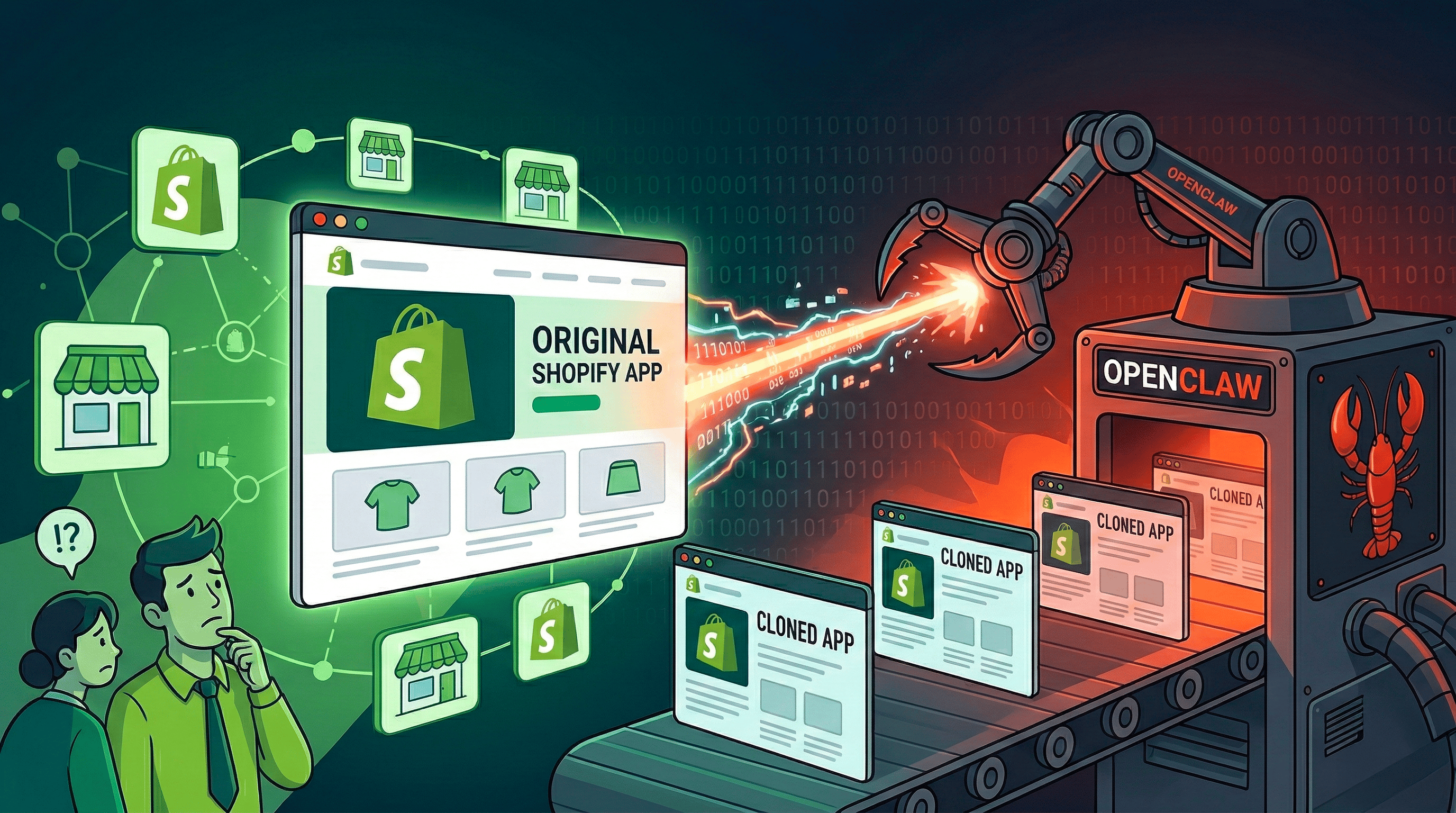
What really happens when a competitor clones your app overnight
The hidden bottleneck that slows down most founders after $10K MRR (it's not code)
What I'd do differently if I started my Shopify app today
Let's go! 🔥
Learn how to grow your Shopify App with this Blueprint
I share everything from building and making $0 to growing and selling for 7-figure. You don’t need to be the best developer or the best marketer.
14-day money back guarantee
What happens when your app gets copied in 30 days
A few years ago, someone reached out to tell me they had spotted a new app on the Shopify store that looked a lot like WideBundle.
Same core feature. Similar UI. Slightly cheaper.
My first reaction was frustration. My second was curiosity.
So I started thinking: why does this keep happening? And more importantly, what do you actually do about it?
Today, with AI and the fame of Shopify, it becomes even more important, and might happen to you too.
Here's the truth. AI has made it dramatically easier to clone a product. What used to take six months now takes weeks. Sometimes days. The cost of shipping a feature is going down fast, and it's not going to stop.
That means defensibility is no longer about features.
If your only moat is "we have this feature and they don't," that moat will be filled in. Maybe not today. Maybe not in a year. But eventually.
So what actually protects you?
The first thing is distribution. Not just traffic, but relationships. The app that a successful Shopify agency recommends to their 50 clients is not easy to displace. Not because the product is better, but because trust has already been built. A cloned feature doesn't come with a trusted relationship.
The second thing is your community. I've said this before, but merchants who feel like they know you, who have talked to you in DMs, who came to The Wide Event, who read this newsletter, they don't switch easily. It's not because they're loyal in some abstract way. It's because switching has a human cost, not just a technical one.
The third thing is speed. Not building speed, execution speed. A competitor can copy your feature. Can they copy the speed at which you ship the next one? Can they copy your support quality? Can they copy the pace at which you respond to market changes?
Probably not. At least not right away.
And the fourth thing is your brand as a founder. This is the one that surprised me the most when I started thinking about it. People install WideBundle partly because of Mat. Because they've seen tweets, read emails, watched videos. There is a person behind the product. A clone doesn't have that. It starts from zero.
Here's what I've seen happen with competitors who copied something I built:
They got some installs. Some traffic. Some attention.
And then they stalled. Because installs are the easy part. Retention, trust, word of mouth, community, none of those can be copied from a GitHub repo.
The lesson here is not "don't worry about competition." Competition is real and you should take it seriously.
The lesson is: stop building a product that can be fully described in a feature list. Start building something that includes you, your relationships, your community, and your execution speed.
That is the moat that doesn't disappear in 30 days.
There's a moment in every app's growth where something feels off.
You're shipping. Revenue is growing. You have users. From the outside, everything looks fine.
But inside, you feel slow. Unfocused. Tired by 3pm. Making decisions that you're not confident in.
Most founders I talk to assume the bottleneck is technical. A missing feature. Not enough traffic. A bad onboarding flow.
In a lot of cases, the real bottleneck is decision fatigue.
Let me explain.
When you're early, decisions are simple. Do we build this or that? Do we charge or go free? You make a call, you move on. There aren't that many of them.
As you grow, the surface area of decisions expands.
Should we prioritize this bug or that feature? How do we respond to this pricing complaint? Should I take this partnership call? Do we raise prices? Do we add this integration? Should I hire someone for support? What about this merchant who keeps escalating?
Every single one of these decisions is small. But they accumulate. And by the end of the day, your brain has made a hundred micro-decisions and has nothing left for the important ones.
This is what slows you down more than any missing feature.
I noticed this in my own work when I started dreading my inbox. Not because the emails were hard. But because every one of them required a decision. And I was making them all alone.
The fix is not to work harder or to build better systems (although systems help). The fix is to make fewer decisions.
Here's how I think about it:
The first move is to make decisions once and never again. If a merchant asks the same question three times in a month, that's not a support problem. That's a decision that needs to be made once, written down, and delegated. "Here is how we handle refund requests." Done. No more thinking.
The second move is to accept that some decisions don't need to be made right now. I used to feel like every incoming request needed an immediate response. It doesn't. A lot of "urgent" things stop being urgent if you wait 24 hours. The world doesn't end.
The third move is to protect your morning. The first two hours of your day are your clearest thinking time. Don't fill them with email, Slack, or support tickets. Use them for the one decision that actually matters that day.
The fourth move is to delegate the decision, not just the task. This is the hard one. When you hire someone for support, you have to give them the authority to actually decide things. Not "handle this and escalate if needed." That just adds a loop. Give them the framework and trust them to use it.
And honestly, the most important thing I've learned is this: most decisions are reversible. You won't ruin your app by choosing the wrong pricing tier. You can change it. You won't destroy a merchant relationship by saying no to a feature request. They'll survive.
The weight we put on decisions is often much heavier than the decisions themselves deserve.
When your brain is clear, you move faster. You build better. You communicate better.
And that is a competitive advantage that nobody can copy.
In a world of AI, everything is built and done fast. You’ll have to make even more decisions. So take care.
What I'd do differently if I started my Shopify app today
When I launched my first Shopify app in 2017, I had no clue what I was doing.
No network. No knowledge. No process.
I built things nobody wanted, then spent months figuring out why nobody installed them.
Looking back, I know exactly what the problem was.
And I know exactly how AI would have changed everything.
Validation: the part that took the longest
The most important thing I did back then was not writing code.
It was talking to people.
Every Facebook group. Every community. Every live conversation I could get into. I was looking for problems. Real ones. The kind merchants complained about every week.
Once I found a potential problem, I had to manually confirm it was not just my impression. I had to find more people with the same frustration. Then talk to them. Then build something with them.
That process took months.
And honestly, it still should. Real conversations with real merchants are still the most important thing you can do when validating an app idea. AI does not replace that.
But what AI changes is everything around the conversations.
Today I would use AI to scan LinkedIn and Twitter to find the right merchants before reaching out. Not just any merchant. The ones who are actively struggling with the problem I want to solve.
I would use AI to send personalized outreach at scale. One message per lead, adjusted to their profile, to start a conversation. Then the moment someone responds, I take over. The human conversation stays human.
I would also set up automated Reddit monitoring from day one. Subreddits about Shopify, about e-commerce, about specific niches. AI reading every post every day and flagging anything that looks like a problem worth solving.
And I would scrape the Shopify App Store reviews to find patterns. What do merchants love. What do they hate. What do they wish existed.
The goal is simple: find signals at a scale that is impossible to do manually.
Because you can't read every post, every thread, every review every single day. But AI can.
Getting to the first installs
My biggest obstacle going from zero to the first real installs was not technical.
It was finding a problem merchants were ready to act on right now.
Not eventually. Not "it would be nice if." Right now.
That core truth hasn't changed. But the way you find those merchants, reach them, and convert them into first users has changed completely.
Here's what I would actually do today.
The AI-assisted outreach I described in the validation phase doesn't stop once you've confirmed the idea. Those same merchants you contacted to validate the problem are your first installs. You've already had a conversation with them. They told you they have the problem. Now you send them a message: "I built something. Can you try it?"
That's your first install.
AI helped you find them at scale. AI helped you reach out in a personalized way. You never could have done that volume manually.
Once they're in, the next challenge is keeping them. And that's where most early-stage founders lose users without realizing it.
When I launched WideBundle, I was still in school. I couldn't answer support messages in the morning. Some merchants would wait hours. A few would uninstall before I even saw their question.
Today I would set up an AI support layer from day one. It handles the first response. It answers the common questions. It keeps the merchant engaged while I'm not available.
That alone changes retention in the first week. And in the Shopify App Store, the first week matters a lot.
At the same time, I would use AI to build the app faster. Not to skip the conversations with merchants. But to run them in parallel. You talk to merchants in the morning. You vibe-code the MVP in the afternoon. The feedback loop becomes days instead of months.
I remember a product I worked on in 2019 called Wide Checker. Not a Shopify app, but something I spent months on. I eventually had to drop it. Too complex technically. Too many repetitive tasks I couldn't automate. I was paying virtual assistants to do things that were slow, expensive, and impossible to scale.
With AI, that project would have looked very different. The repetitive tasks go away. The technical complexity gets absorbed. And I would have been able to move much faster.
The thing I would set up from day one, beyond the AI support layer, is a knowledge base.
Every support conversation. Every bug report. Every question a merchant asks. Automatically logged, summarized, and stored. So that when the same issue comes back three months later, you don't have to remember. You search, you find, you fix.
That knowledge base becomes more valuable every week. It's the institutional memory you don't have as a solo founder.
When things start growing
Here's when AI really changes the game.
Once you have users, the real work begins. Support gets heavier. Feedback comes from everywhere. The roadmap grows faster than your ability to execute.
I use AI today to go through all the support tickets and extract feature ideas. To take user call recordings and turn them into structured insights. To translate raw feedback into a clear roadmap.
Before, I would re-watch recordings manually. I would try to remember what a merchant said three weeks ago. Now the information is there, structured, searchable.
I also use AI to fix bugs faster. I describe the issue to my AI agent, it investigates, proposes a fix, tests it, and pushes to GitHub. I review and merge.
That's not magic. That's just moving faster.
The thing nobody talks about
Here's what I think is the fundamental shift.
Before AI, a solo developer competed against teams of five or ten people who moved faster. That was the disadvantage. Speed.
Today, being solo can actually be a strength. You don't split attention. You don't manage people. You have one direction and you execute on it with AI doing the heavy lifting.
That's a superpower.
But here's the part I want you to think about.
AI lowers the technical barrier to entry. That means more apps. More competition. More noise.
What goes up at the same time is the marketing and differentiation barrier.
You can no longer win only on features. Everyone will have the same features. They will be built in a week.
What matters more and more is your ability to talk to your audience. To be liked. To communicate clearly. To have real conversations. To run calls where merchants trust you.
The skills that AI cannot replace are the human ones.
That's not a weakness of AI. That's just the truth.
The best Shopify app founders in the next five years will not necessarily be the best coders. They will be the ones who know how to build relationships, communicate value, and understand people.
AI makes the technical side easier. The human side matters more than ever.
 | The Shopify App Growth BlueprintIf you want to get the whole theory on how to grow a successful Shopify App from $0 MRR to a 7-figure EXIT, grab it now! |
Thanks for reading!
I’ll see you in the next email, in 14 days. Until then, take care!
Mat.